A 2018 viral hoax claimed MAPs (minor-attracted persons) were trying to join LGBT+. Much of the general public views MAPs as predators, so the hoax drew vehement resistance from many LGBT+ people. Who wants to be associated with predators? Of course it went over like a lead balloon!
Moreover, in LGBT+ history, this hoax was far from the first smear of its kind. Detractors of the LGBT+ community have consistently attempted to associate the community with child sexual abuse (CSA). They have likened gay men to pederasts. They have claimed transfeminine people using women’s restrooms are trying to molest little girls. More broadly, they have claimed LGBT+ influences corrupt children’s minds and morals.
None of the vilification is valid. Expressions of LGBT+ identities have no inherent association with sexual abuse of anyone, let alone children. Nevertheless, the LGBT+ community has long suffered from such perceptions.
Part of the muddied perception has involved organizational association. North American Man-Boy Love Association (NAMBLA), a pederasty advocacy group, used to be a member of the International Lesbian and Gay Association (ILGA). NAMBLA marched in some gay pride parades. The Associated Press reported in 1994, “[T]he annual gay pride march in Los Angeles excludes NAMBLA, but the marches in New York and San Francisco have allowed it to participate.” While not the most flattering depiction, this AP article notes, “The gay community has historically been inconsistent in its response to pedophiles, leaving itself open to attack.”
To their credit, ILGA eventually expelled NAMBLA. The ILGA website records, “In 1994, ILGA expelled NAMBLA and two other paedophile groups at its World Conference in New York. These groups had joined ILGA at an earlier stage of ILGA’s development, at a time when ILGA did not have in place administrative procedures to scrutinize the constitutions and policies of groups seeking membership.”
Human Rights Campaign in a 2010 statement also denounced CSA (which they likewise termed pedophilia).
Thus, the LGBT+ community’s vehement resistance to association with CSA did not suddenly arise in 2018; decades of controversy have formed it.
LGBT+ has historically been about 1) the gender one identifies as, if any; and 2) the gender(s) to which one is romantically or sexually attracted, if any. Minor attraction has nothing to do with the gender(s) one identifies as or is attracted to, if any.
Therefore, minor attraction lacks sufficient precedent for inclusion in LGBT+. The two must remain separate and distinct. Now this blog post should end here, having made its point… except for one problem.
The problem is the general public often conflates minor attraction and CSA. However, most MAPs never commit CSA, and most CSA is committed by non-MAPs (per Dutch Rapporteur ‘On solid ground. Tackling sexual violence against children.’ and B4U-ACT ‘Research Summary’). Like LGBT+ people, MAPs are vilified with a “Think of the children!” knee-jerk reaction. Acting in self-preservation, many LGBT+ people throw MAPs under the bus.
To protect children and preserve the integrity of LGBT+, one does not need to condemn MAPs. Minor attraction is unchosen. Simply having an attraction does not make us dangerous or despicable. Much of the general public views us as disgusting predators, so we live under the burden of stigma. We are pressured to hide and repress our attractions instead of being open and honest about them. If we disclose our attraction, we risk social ostracism, termination from employment, or vigilante violence even when we have done nothing reprehensible.
This piece explores the similarities and differences between LGBT+ and minor attraction. Finally it proposes a new, broad categorization.
Similarities
1) Minor attraction and LGBT+ sexualities are innate, inseparable from one’s personhood. One cannot love or accept a person while hating or rejecting their sexuality or gender. “I consider gayness sinful but I love gay people” doesn’t make sense, since gayness cannot be separated from the person. Likewise, “I detest minor attraction but I accept MAPs” is a harmful message.
The American Psychiatric Association (APA) removed homosexuality from the Diagnostic and Statistical Manual of Mental Disorders (DSM) in 1973. Then in 1974, they added ‘Sexual Orientation Disturbance,’ which classified homosexuality as a disorder only if it bothered the person:
Perhaps as a concession to those against the 1973 decision, a new revision of the DSM, called DSM II, was published in 1974 and replaced homosexuality with Sexual Orientation Disturbance, which regarded homosexuality as an illness only if the person was “disturbed by, in conflict with, or wished to change their sexual orientation” (APA DSM II). The DSM II noted that homosexuality by itself did not constitute a psychiatric disorder. A later edition […] renamed Sexual Orientation Disturbance as Ego Dystonic Homosexuality, but that too was removed in a revision in 1987 […]. (cedar.wwu.edu)
The DSM’s treatment of homosexuality from 1974 to 1987 is much like its current treatment of pedophilia. The DSM-5 considers pedophilia a disorder only if it bothers or impairs the person or they have committed CSA. The entry for Pedophilic Disorder explains:
However, if they report an absence of feelings of guilt, shame, or anxiety about these impulses and are not functionally limited by their paraphilic impulses […], and their self-reported and legally recorded histories indicate that they have never acted on their impulses, then these individuals have a pedophilic sexual interest but not pedophilic disorder.
2) Both have been targeted for conversion therapy. Individual psychiatrists and psychologists have attempted it, as well as entire organizations dedicated to it, against gay and trans people. On a smaller scale, it has been attempted against MAPs.
Perhaps the most common message MAPs receive from those who don’t understand us is “Get help!” It often comes from LGBT+ people who are okay with conversion therapy for certain sexualities but not for their own.
One’s sexuality cannot be changed by denial, repression, prayer, conversion therapy, chemical castration, or physical castration. For those last two, it is notable that some MAPs are assigned female at birth.
3) As stated above, detractors often invoke “Think of the children!” for both. I’m a MAP and LGBT+, specifically transfeminine. I use women’s restrooms because using men’s restrooms gives me dysphoria. Transfeminine people are already often perceived as predatory to little girls in restrooms. Knowing I’m also a MAP could give someone even greater reason to view me as a predator, compounded with my gender expression.
This is also why the blanket statement “MAPs aren’t LGBT+” is unhelpful, since some people are both. It would be more helpful to say, “Minor attraction isn’t LGBT+.”
4) People in both categories are disproportionately likely to have the anxiety/depression/suicide trifecta. This is due partly to stigma and pressure to hide and repress one’s innate qualities. People in both categories deserve to be able to talk about their genders and sexualities without stigma, shame, or condemnation.
5) Both can involve emotional or romantic attraction. It is common knowledge in the LGBT+ community that one’s sexual attractions and emotional/romantic attractions don’t always match. Also, it is common knowledge in the MAP community that minor attraction can be sexual or emotional/romantic. Some MAPs are asexual and have only emotional/romantic attraction to minors. Some MAPs are aromantic and have only sexual attraction to minors. Most MAPs have simultaneous sexual and emotional/romantic attraction.
A MAP can fall in love with a child in the same sense in which an adult falls in love with another adult. In such cases, it does not necessarily increase the risk of the MAP offending against the child. Rather, it can give the MAP that much more motivation to protect the child. It is also possible to love from a distance, to avoid crossing appropriate boundaries.
6) Both can be apparent in minors as well as in adults. Many minors are themselves MAPs. For example, a 14-year-old attracted to four-year-olds is a MAP because of the large age gap.
Differences
1) Adults can consent to sex with each other, but children cannot consent to sex with adults. Age matters for consent, but gender doesn’t.
2) The first gay rights organization in the United States, albeit short-lived, was the Society for Human Rights (1924-1925). The more successful Mattachine Society began in 1950 and made some progress, until the LGBT+ movement gained strong traction in 1969 with the Stonewall riots. The movement has been mostly supported by the Democratic Party, the Libertarian Party, and the Green Party. The Republican Party has mostly opposed it. It has won many victories in the public sphere.
The MAP movement, by contrast, began much more recently and has not yet received political attention. It is Internet-based because nearly all MAPs prefer to remain anonymous. Several students in psychology have studied MAPs in the MAP community, including questionnaires and one-on-one interviews. One such researcher is Crystal Mundy, M.A., whose dissertation is in committee review at the University of British Columbia.
For the sake of some readers, I stress Nathan D. Larson (former Libertarian, now independent) and Roy Moore (Republican) do not represent the MAP community. A good representative of the MAP community is Todd Nickerson, though he has not to my knowledge run for public office. I don’t know when or how the MAP movement will enter politics or what it will look like; but it will be more respectable than Larson, Moore, or NAMBLA.
3) LGBT+ people have historically been persecuted by governments and religions. MAPs have not been persecuted to anywhere near this extent, mainly because MAPs haven’t been as visible. As MAPs become more visible in the near future, MAPs will likely be persecuted to the same degree. Society always has a scapegoat minority.
Personally, I feel more marginalized for my minor attraction than for my nonbinary gender; the former is the one I have to hide and repress the most by far.
Proximation
Clearly, minor attraction and LGBT+ are separate categories. Some people are in both.
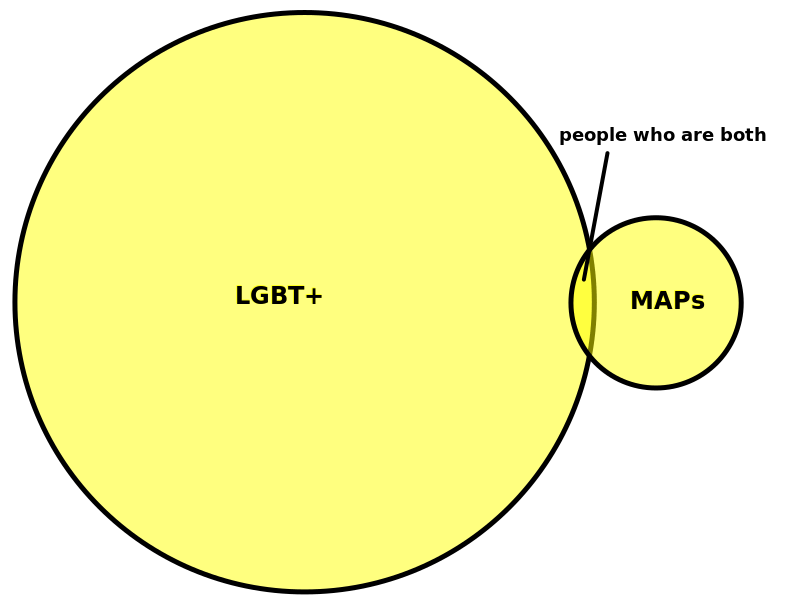
People in either category deserve social justice. While this looks slightly different between the categories, they have at least these three needs in common:
1) Neither should come with stigma, shame, or condemnation.
2) Both should have legal employment protections. This should include day care centers and K-12 schools, since attraction is not action; to suggest otherwise would be to make a stigmatizing assumption that they are inherently dangerous and untrustworthy.
3) Therapy for both should focus on the health and well-being of the person, not on prevention of sexual abuse, unless they have already offended or indicate they want help to keep from offending.
To express these common needs, some have suggested proximal categorization. One idea is the larger category ‘Gender and Sexual Minorities’ (GSM), which includes LGBT+ and minor attraction as separate subcategories. I like the gist of GSM. I would simply rename it for three reasons:
1) A group does not have to be a minority to be marginalized. In United States census data from 2000 and 2010, respondents identifying as female have slight majorities over those identifying as male. These data erase nonbinary identities, but the United States may very well have more women than men. Yet American women are still marginalized. To use an extreme example, at one point in ancient Sparta, slaves outnumbered citizens 8:1.
2) Not all sexual minorities are marginalized. Demisexuality and sapiosexuality are minorities yet not marginalized.
3) Some romantic attractions are in LGBT+, and these are not sexualities or genders. The general word attractions instead of the specific word sexualities would include romantic as well as sexual attractions.
Accordingly, instead of ‘Gender and Sexual Minorities’ (GSM), I propose ‘Marginalized Genders and Attractions’ (MGA).
I would also include polyamory. There is debate as to whether to classify polyamory as inherently LGBT+, but it is an attraction. Its proper position in my proposed chart below may be different from where I have tentatively placed it.
I would also include zoophilia and necrophilia. Nobody deserves to live with stigma just for having an unchosen attraction.
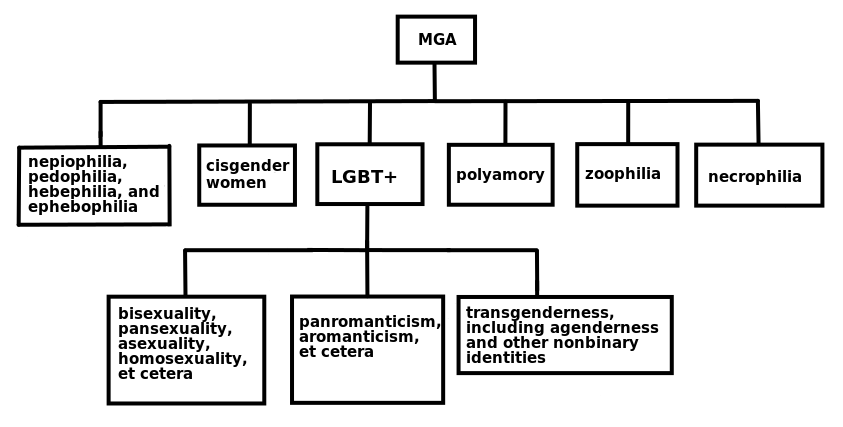
What do you think?
 Mx. PDFphile
Nicely done and well researched piece.
“Marginalized” is descriptive of the here and now, but it could be taken as pessimistic about the perhaps improved future. Lecter and I had a poll once about union terms and what emerged was the term that the chat I saw this link in is named after – “non-normative identities.” Even this assumes that one sexual orientation group is ‘normative,’ but since they reproduce most of the rest of us, that might be a fair concession.
LikeLike