This year was my third time hosting Mapping Hour. The first two, 2023 and 2024, were much alike each other—simply for social justice and wellbeing for MAPs. This year, I wanted to further develop the theme.
Background
I had been barred from a community in September 2024. I felt scapegoated. Shortly thereafter, in October 2024, I had my own private ritual and meditation with Azazel on Yom Kippur.
By that point, Azazel had been one of my spirit guides for a little longer than a year. He and I had initially met in a much different context. I wasn’t aware of his association with scapegoats until September 2024, when I decided to re-read Leviticus 16.
Azazel took an active role in directing my ritual with him in October 2024. While I had a general idea, he gave specific, in-the-moment instructions. It went well.
Then in early 2025, I was trying to decide on the theme for Mapping Hour 2025. The scapegoat theme felt most prominent. Last month, I entered meditation to discuss it with Azazel.
When I (astrally) arrived in the underworld, Azazel was nearby. We were standing in a large, open area of mostly flat land. He quickly motioned for me to follow him into a building.
It was a temple. We walked through the main hall. Wall nooks held candles to light the interior. About three-fourths of the way through, we stopped near a pedestal in the midst.
He indicated he wanted us to co-host Mapping Hour 2025 there in the astral temple. Doing it this way hadn’t occurred to me. I was briefly taken aback. It would be different from how I had hosted the first two years. Since I trusted his guidance, though, I accepted the encouragement.
Then I showed him an art piece I had commissioned. It was his sigil in the colors of the MAP flag. I asked what he thought of it. He took it from my hands, and sat it on the pedestal in the midst of the temple. He said he wanted it to be the focal point of the energy of the ritual.
I then asked whether there was anything he or I could do in advance, to prepare for the ritual. He began removing energetic attachments from my aura. I asked what it was about.
He said these attachments would have made me subconsciously—without realizing or intending to—energetically attack some participants in Mapping Hour 2025. I was glad he removed them. He continued doing some more work on my aura, then sealed it up.
Once the preparations were complete, I asked him for details of what exactly he would have us do during the ritual. He said he would tell me during the ritual. This meant he would be giving me in-the-moment instructions again. I was satisfied.
I finally bade him farewell, walked out of the temple, returned to my physical body, and ended the meditation.
During Mapping Hour 2025
As Mapping Hour 2025 began, I lit a candle. While staring for a moment, I noticed something peculiar: how wax streaming down the side of a candle resembles teardrops streaming down a face. Mine began welling up.
After gazing upon the candle, I went to the underworld. Azazel met me outside the temple, and we walked inside together. I saw participants’ energies gathering like a ball of light above the sigil.
I approached the ball of light and held out my hands to feel its warmth. There was a pleasant warmth, but also an agitating heat. Could it be the contrary energies of antis, I wondered?
Azazel then reminded me of the principle of polarity: Both support and opposition are forms of energy directed at something. Support and opposition are ultimately not different things, but different poles of the same thing: focused energy.
There in the ball of light above the sigil, the supportive energies of participants and the oppositional energies of antis were mingling. Azazel had me redirect the oppositional polarities whence they came.
Then he and I walked circles around the ball of light, playing sounds with chimes. Once we finished with the chimes, I stopped to admire the now fully supportive ball of energy. Participants’ support continued flowing in. It felt easygoing.
Then he invited me to hold out my hands to the ball of energy once again. He said to “confess over it” all the times I’ve felt scapegoated as a MAP.
Hands outstretched, I poured out years of experiences. Once it felt complete, I lowered my hands, and felt lighter. I then invited my own self-return.
Azazel and I lingered in the quiet stillness. My attention span for the hour was beginning to fade, but remained sufficient to continue.
At the end of the hour, Azazel and I dispersed the ball of energies and sent them to their rightful places. We then invited the self-return of all participants.
Finally, we closed the ritual space. I returned to my physical body and exited meditation.
Conclusion
It went beautifully. I’m glad we did it. I’m glad I had the initiative and confidence to bring it about. I thank all participants for their involvement, and I hope we all got something meaningful from it. And I thank Azazel for ensuring I didn’t inadvertently attack participants 🙂
This year marks seven years since Tumblr user Stenna (they/she) introduced the MAP flag on June 13, 2018. We observe June 13 annually as MAP Flag Day (or MAP Pride Day).
To honor the occasion, I’ve planned a collective ritual. It is a shared hour of focus held simultaneously across many places. I call it the Mapping Hour as a play on the historical “witching hour.” Allies are welcome.
This year’s Mapping Hour centers on the scapegoat—an archetype of unjust blame, and a reflection of how society projects fear, shame, and guilt onto those it marginalizes. This theme strongly applies to MAPs.
The concept of the scapegoat comes from the Yom Kippur ritual. Yom Kippur is Judaism’s holiest day—a time of collective repentance, deep introspection, and return. In the ritual, Azazel receives the scapegoat bearing the sins of the Israelites. For relevant reading, see Leviticus 16 in the Tanakh, as well as Yoma 4 and 6 in the Talmud.
The Hebrew text of Leviticus 16 uses the word ‘aza’zel. Some English translations preserve the name Azazel, while others interpret it as scapegoat; either way, it involves scapegoating. Here is Leviticus 16.7-22 in the JPS Hebrew-English Tanakh:
Aaron shall take the two he-goats and let them stand before the LORD at the entrance of the Tent of Meeting; and he shall place lots upon the two goats, one marked for the LORD and the other marked for Azazel. Aaron shall bring forward the goat designated by lot for the LORD, which he is to offer as a sin offering; while the goat designated by lot for Azazel shall be left standing alive before the LORD, to make expiation with it and to send it off to the wilderness for Azazel. […]
Aaron shall lay both his hands upon the head of the live goat and confess over it all the iniquities and transgressions of the Israelites, whatever their sins, putting them on the head of the goat; and it shall be sent off to the wilderness through a designated man. Thus the goat shall carry on it all their iniquities to an inaccessible region; and the goat shall be set free in the wilderness.
In theory, the scapegoat was released in the wilderness. In practice, however, Yoma 6 records how it was violently “separated limb from limb.”
Image description for the visually impaired: the sigil of Azazel in the colors of the MAP flag, on a black background; art by Blossom (@fl0weringnight@zooey.cat)
As the scapegoat once bore communal guilt, MAPs have long carried society’s condemnation. During this ritual, we send it back—return to sender.
This year’s Mapping Hour unfolds in two sequential phases, each an act of return: First, we release the guilt that was never ours to bear, returning it to its source. Then, we each return to our own inner wholeness—the truth of who we are beneath the blame. As the projection is lifted, the self is reclaimed; it is our teshuvah—not repentance, but restoration.
Mapping Hour will last one hour, starting at 11:00 PM EDT (UTC -4) on June 13. It’s alright if the date is different in your time zone. Join from anywhere with our shared intention. You might journal, pray, meditate, speak verbal affirmations, or use another method that feels right for you.
If you can’t join for the full hour, join for what you can. Even a moment counts. Optionally, you may charge a candle with intention beforehand, then burn it during the hour.
However you participate, your energy matters more than the method or length of time. Let it be a threshold—between projection and truth, between blame and being. As we each cross it, may we return lighter and more whole.
p.s. Some may wonder whether this ritual is antisemitic. I want to clearly say it is not. I oppose unjust scapegoating of people, including the tragic scapegoating of Jewish people throughout history. If anyone has prejudice or hatred toward Jewish people, they’re not invited.
Anticipated Objections & Concerns
“You should do this on Yom Kippur, not on MAP Flag Day.” That’s what I did privately on the night of October 11, 2024. This time, it’s for all MAPs.
“You’re engaging in cultural appropriation.” Azazel is one of my spirit guides, and this Jewish tradition directly involves him.
“Rabbinic interpretations—and even most Kabbalistic interpretations—portray Azazel as dangerous and strongly discourage approaching him. By inviting us to invoke Azazel, you’re misrepresenting Jewish tradition.” You’re correct that Jewish tradition frames Azazel negatively. I’m not interested in Azazel because Jewish lore includes him; rather, the causal relationship is the other way around: I’m interested in Jewish lore because it includes Azazel.
“Are you sure Azazel is alright with this ritual, and with his sigil being colored?” Yes.
“But demons are evil!” So are MAPs, supposedly 😛
“The Stenna flag isn’t the only MAP flag, and I prefer another flag/no flag at all.” You can participate with another flag or no flag at all.
“Association with witchcraft harms our public image.” You don’t have to participate.
“This ritual is sinful/evil according to my religious/spiritual beliefs.” You don’t have to participate.
“This practice is pseudoscientific because no empirical evidence supports its efficacy.” You don’t have to participate.
Blossom’s contact information for art commissions:
June 13 is MAP Flag Day/MAP Pride Day. It will be six years since Stenna (they/she) posted our flag in 2018. I have planned a collective ritual for the day.
The ritual will last one hour. Wherever you are, focus on social justice for MAPs and our wellbeing. You might pray, meditate, speak words of affirmation, invoke a deity or spirit, cast a spell, et cetera. Whatever you do during the hour, hold space for the energy.
If you can’t participate for the entire hour, participate as long as you can. Even a brief moment during the hour would be something. You might charge a candle with intention beforehand, then burn it during the hour (but don’t leave it unattended).
Some of you might not be available for any portion of the hour. You can write a message and send it to me before the ritual, so I can read it aloud on your behalf during the ritual. If you are sending me a message to read aloud, please provide a name/alias to say whom it is from; and please say whether you are comfortable with me publicly sharing your name/alias. I might also need clarification on pronunciation of names/aliases.
The ritual begins at 20:30 Pacific Daylight Time, which is 8:30 PM in Los Angeles.
I call it the ‘Mapping Hour’ as a play on the historical ‘witching hour.’ Allies are welcome to participate.
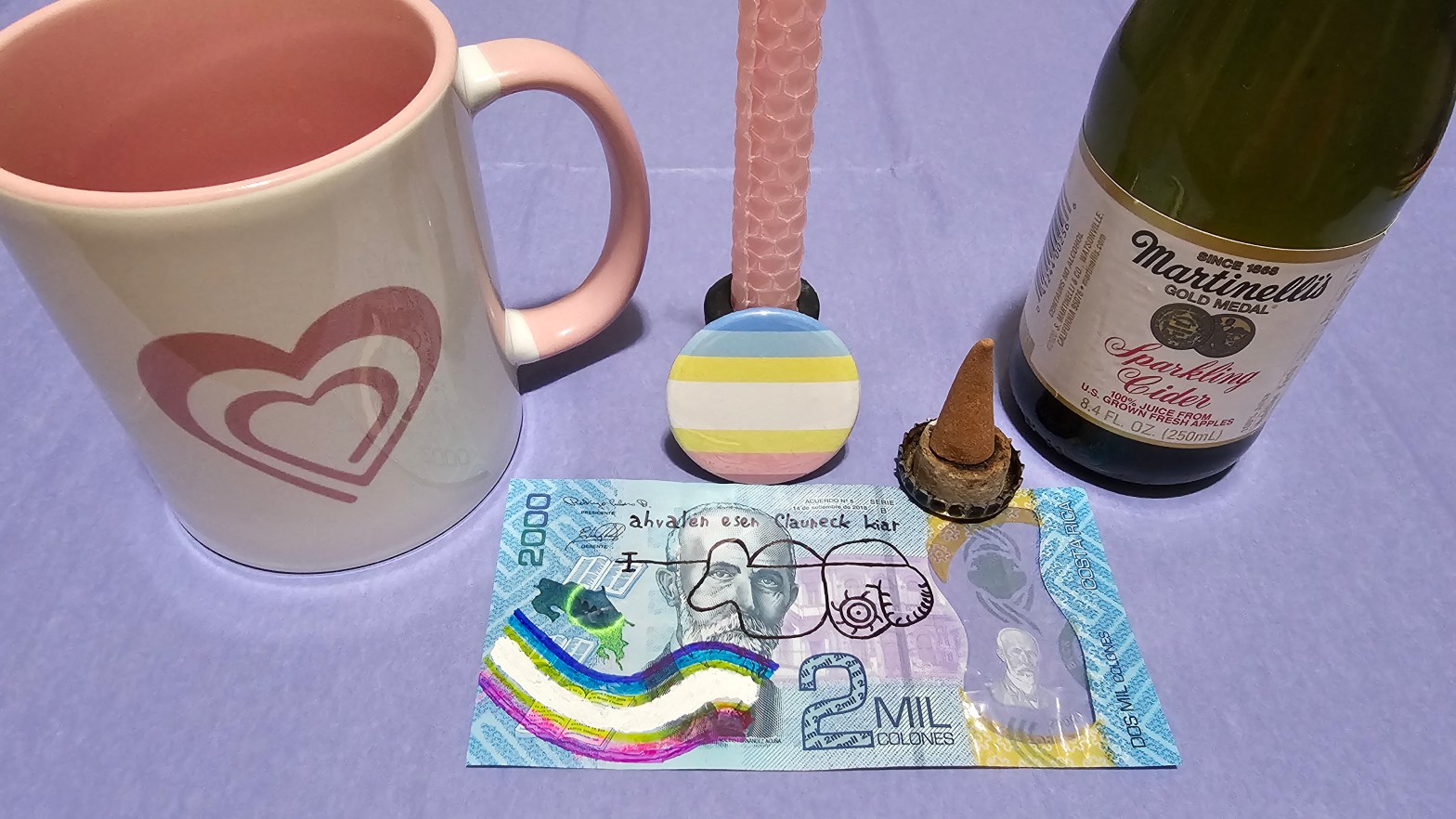
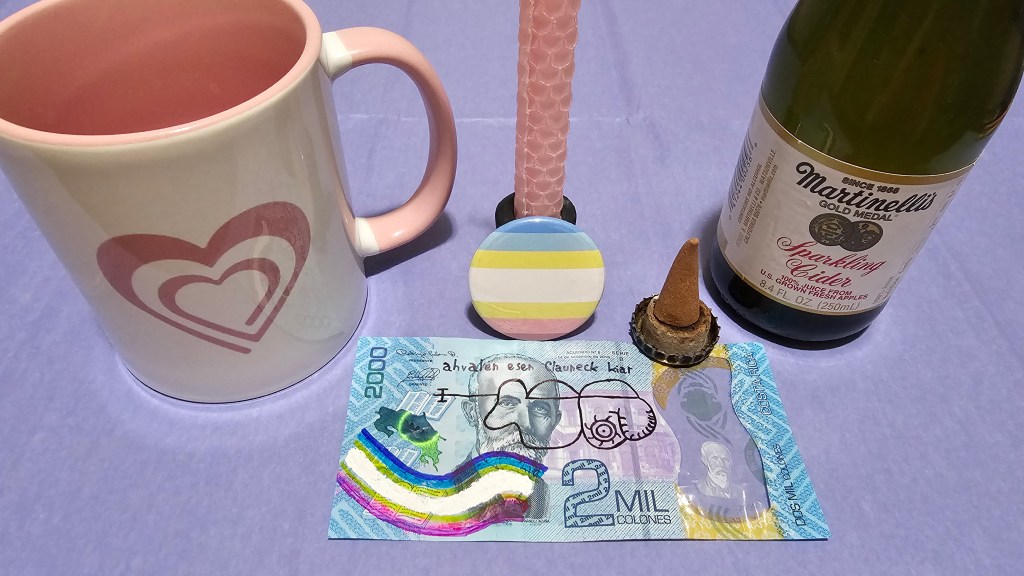
[Image description for the visually impaired: Objects sit on purple tissue paper. Some of these objects are a drinking mug with the GL symbol, a small bottle of Martinelli’s sparkling apple cider, an incense cone on a tiny stand, a small pink candle in a stand, and a round lapel pin with the MAP flag. The other item is a 2,000-colones banknote from Costa Rica. The obverse of the banknote is facing up. At about the center of the obverse, the sigil of Clauneck has been drawn in black ink, with his enn also in black ink just above: “ahvalen esen Clauneck kiar.” At the lower left of the obverse, a stylized MAP flag has been drawn.]
inb4 “Association with witchcraft harms our public image.” You don’t have to participate.
inb4 “This ritual is sinful/evil according to my religious/spiritual beliefs.” You don’t have to participate.
inb4 “This practice is pseudoscientific because no empirical evidence supports its efficacy.” You don’t have to participate.
inb4 “The Stenna flag isn’t the only MAP flag and I prefer another one/no flag.” You can participate with another flag or no flag at all.
inb4 “But demons are evil!” Supposedly, MAPs are also evil. Don’t believe everything you hear.
inb4 “Why Clauneck?” ’cause i feel like it
inb4 “Why Costa Rican colones?” ’cause i feel like it
inb4 “Why use money instead of just regular paper?” ’cause i feel like it
inb4 “Why so many inb4 lines?” ’cause i feel like it
This post is for those who believe in the power of focusing intention.
June 13 is MAP Flag Day/MAP Pride Day. It will be five years since Stenna posted our flag in 2018. I have planned a collective ritual for the day.
The ritual will last one hour. Wherever you are, focus on social justice for MAPs and our wellbeing. You might pray, meditate, speak words of affirmation, invoke a deity or spirit, cast a spell, et cetera. Whatever you do during the hour, hold space for the energy.
If you can’t participate for the entire hour, participate as long as you can. Even a brief moment during the hour would be something. You might charge a candle with intention beforehand, then burn it during the hour (but don’t leave it unattended).
Some of you might not be available for any portion of the hour. You can write a message and send it to me before the ritual, so I can read it aloud during the ritual. If you are sending me a message to read aloud, please limit it to 75 words, and provide a name to say whom it is from. I might also need clarification on pronunciation of names.
The ritual begins at 17:15 UTC on June 13, 2023. Here is the start time in several time zones:
HST (Honolulu, Hawaii) – 7:15 AM
AKDT (Anchorage, Alaska) – 9:15 AM
PDT (Los Angeles, California) – 10:15 AM
MDT (Denver, Colorado) – 11:15 AM
CDT (Dallas, Texas) – 12:15 PM
EDT (Baltimore, Maryland) – 1:15 PM
BRT (Rio de Janeiro, Brazil) – 14:15
BST (London, United Kingdom) – 18:15
CEST (Berlin, Germany) – 19:15
MSK (Moscow, Russia) – 20:15
IRST (Tehran, Iran) – 20:45
IST (New Delhi, India) – 22:45
I’m calling it the Mapping Hour, a play on the historical ‘witching hour.’ Allies are welcome to participate.
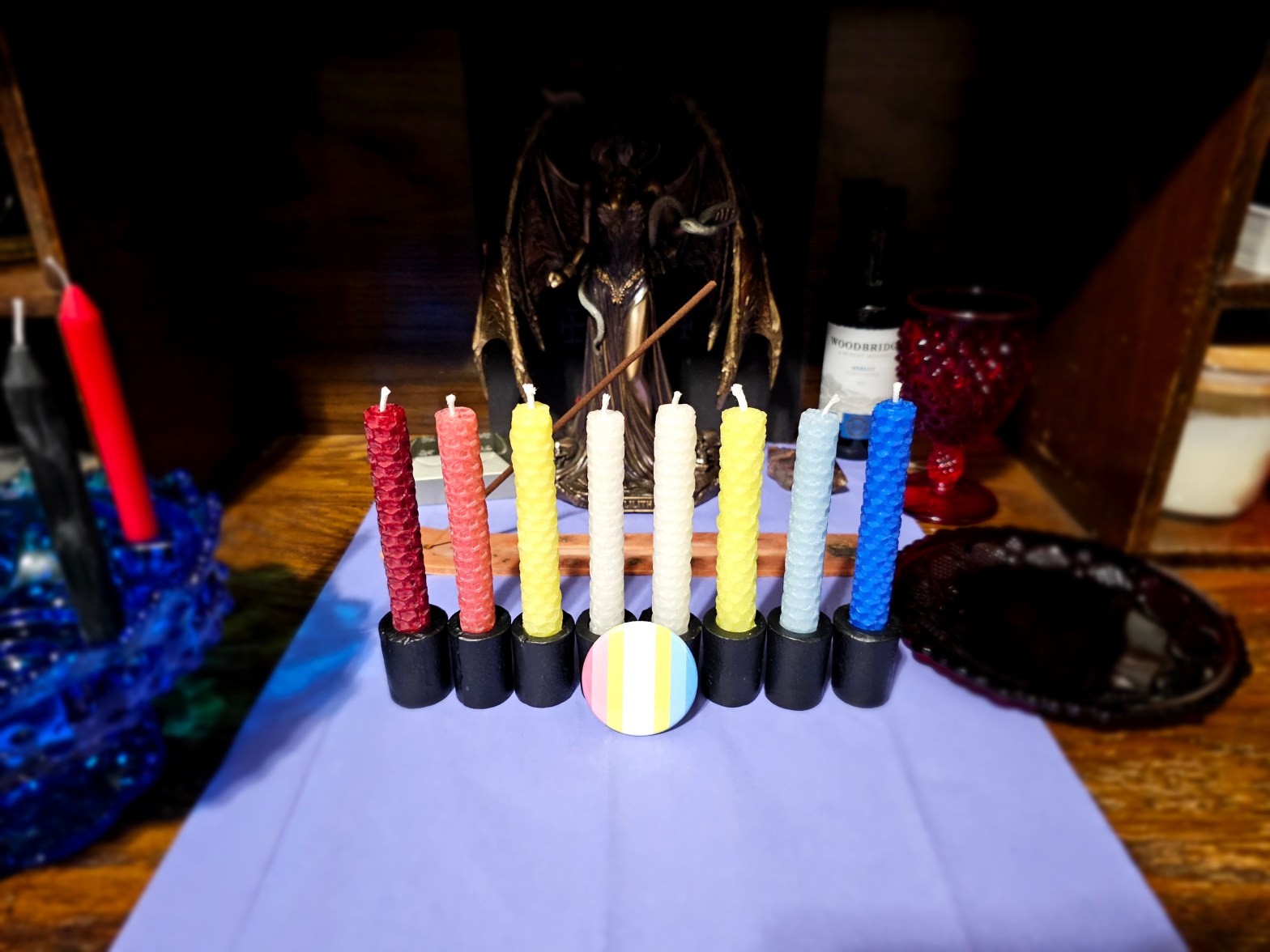
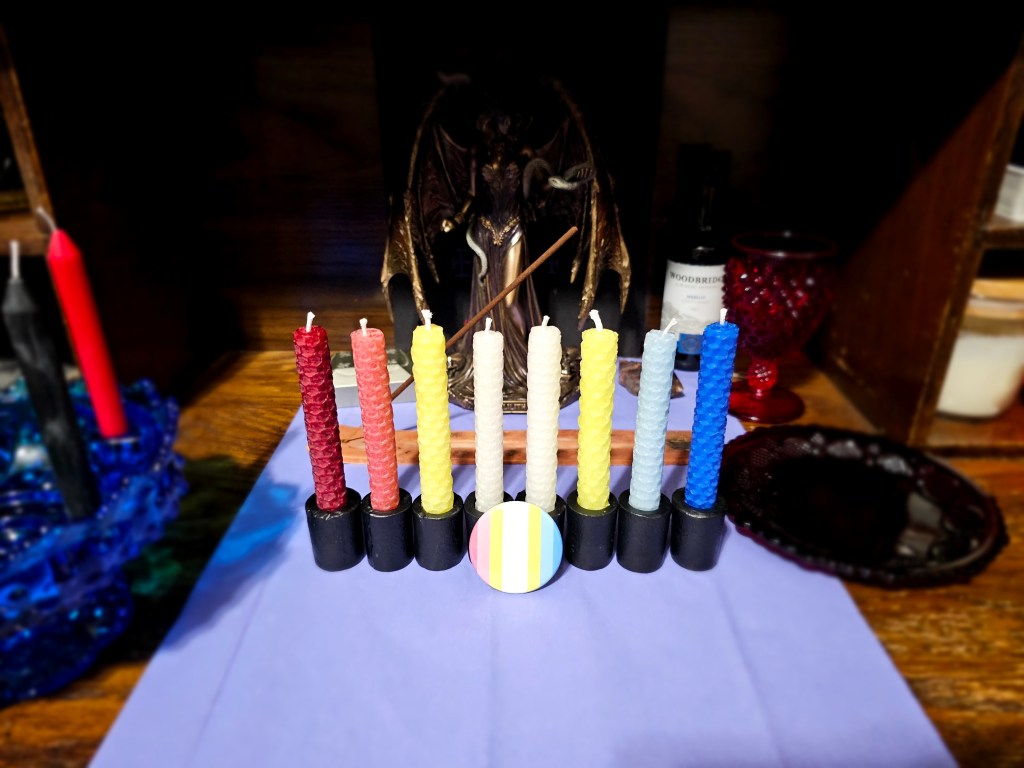
[Image description for the visually impaired: Eight beeswax candles, each 4″ tall and 0.5″ in diameter, stand in a row in cast iron candle holders. These candles are arranged by color in the pattern of the MAP flag. Behind these candles is a stick of incense held diagonally in a wooden incense holder. Behind the incense stick is a 9″ tall, cold cast resin statuette of Lilith. All these objects are on lavender-colored tissue paper on a wooden desk with its own backing. A few other small objects are also on the desk.]
inb4 “The Stenna flag isn’t the only MAP flag and I prefer another one/no flag.” You can participate with another flag or no flag at all.
inb4 “This practice is pseudoscientific because there’s no empirical evidence it has real effects.” You don’t have to participate.
inb4 “This ritual is sinful/evil according to my religious/spiritual beliefs.” You don’t have to participate.
inb4 “I’m concerned the association with witchcraft could worsen our public image.” You don’t have to participate.
Update on June 13, 2023: Below is a video from the ritual.
To notice how ridiculous the fearmongering sounds about a marginalized group, it can help to flip the messages back onto the dominant group. If something sounds ridiculous when said of the dominant group, it’s probably also ridiculous when said of the marginalized group.
In the case of MAPs, this means flipping the messages back onto teleiophiles (people primarily attracted to adults in their prime). Most people are teleiophiles, since most people are primarily attracted to adults in their prime.
~*BEGIN SATIRE*~
Teleiophiles can’t be trusted around adults. They are predators and will strike at any chance they get!
Teleiophiles also can’t be trusted around computers. They’ll download adult porn any chance they get. Search a teleiophile’s hard drive and you’re sure to find it!
Any decent teleiophile would make every effort to stay away from adults. They can’t resist their urges.
If someone is attracted to adults, they shouldn’t tell anyone. Friends, family, and coworkers would rightfully be disgusted. A therapist can help them control their attraction.
Teleiophiles must recognize it’s not okay to be attracted to adults. It doesn’t matter whether they rape adults; the attraction itself is wrong. Thoughts are harmful. Therefore, “non-offending” teleiophiles are still offenders just by existing.
To prevent abuse of adults, we must understand how to treat those with attraction to adults. Treatment can include conversion therapy by chemical castration, since all teleiophiles have testicles. If any teleiophile is found not to have testicles, electroshock therapy is preferred.
We need to figure out what causes teleiophilia. It’s probably exposure to media that sexualizes adults. If we restrict such media and reduce people’s exposure, fewer people will catch teleiophilia.
When teleiophiles are alone in their own bedrooms, they touch themselves while thinking about adults. It’s disgusting!
In Oklahoma, notorious teleiophile Daniel Holtzclaw abused his authority as a policeman to commit teleiophilia. Bill Cosby is another serial teleiophile.
And it’s not just individual teleiophiles preying on adults. Some sex traffickers even operate teleiophile rings!
Elite teleiophiles, including Justices Clarence Thomas and Brett Kavanaugh, control the world.
I was sexually assaulted by a teleiophile. Therefore, I have a right to condemn all teleiophiles and claim teleiophilia caused my assault.
Teleiophiles emit invisible trauma rays that traumatize all adults within a one-kilometer radius.
Get help!
~*END SATIRE*~
That’s how ridiculous it sounds when people fearmonger about MAPs.
This piece presents a commonly accepted principle. First it describes application of the principle in two contexts. Then it describes nonapplication in a third context. Finally it argues for application in all three contexts.
The principle is that attraction does not equal action. Attraction and action are distinct and separate. Attraction does not eliminate one’s ability to make decisions. Regardless of attraction, one can decide whether to engage in action.
The first context is feminism, specifically sexual assault prevention and survivor advocacy. The second context is the gay rights movement.
In the first context, feminists apply the principle to rebut the view that men are just animals who can’t resist assaulting a sexy woman. This animalistic view coincides with blaming women for their assaults. The all-too-familiar “What were you wearing?” comes to mind. Many men repeat the drivel, “She was asking for it with that short skirt” or, “How could any man resist a body like hers?” In doing so, they misplace the responsibility for assault onto the survivor and insult themselves as men.
That view attempts to characterize men—chiefly cishet men—as dogs salivating over pieces of meat. In reality, a dog can be trained not to disturb a juicy steak when their master says “No.” Thus, it characterizes men as less responsible than dogs.
The principle that attraction does not equal action corrects that view. This principle can give men a higher view of themselves—both to avoid blaming women for their assaults and to avoid self-deprecation.
Women who are attracted to men can refrain from assaulting men. Men who are attracted to women can refrain from assaulting women. No difference whatsoever.
In the second context, gay people apply this principle to rebut the criticism that they are inherently more lascivious than straight people. Historically, straight people have characterized gay people as perverted or sex-crazed. One is not ‘addicted’ to sex simply for being bisexual, for example.
Also, many homophobic men fear gay men will make advances toward them. One may quip, “Homophobia is the fear that other men will treat you as you have treated women.” Gay people apply this principle to assuage such baseless fear.
Straight people can choose whether to refrain from, or engage in, sexual activity. Gay people can choose whether to refrain from, or engage in, sexual activity. No difference whatsoever.
I fully support and agree with the above applications of the principle. And with this piece, I support application in a third context.
The third context is minor attraction. In this context, many people conflate attraction and action. They assume sexual attraction to minors means sexual behavior toward minors. They consider anyone attracted to minors a ‘predator’ who will ‘strike’ at any chance. They believe minor-attracted persons (MAPs) inherently have a ‘propensity’ to molest children.
Having an attraction to children does not mean believing child molestation is acceptable. It does not impair one’s ability to understand sexual ethics. MAPs are not inherently more lascivious than anyone else.
Someone who is sexually attracted to adults can refrain from sexual behavior with adults. Someone who is sexually attracted to minors can refrain from sexual behavior with minors. No difference whatsoever.
The principle that attraction does not equal action is as applicable to minor attraction as to feminism and gayness. Condemning MAPs for our attractions doesn’t protect children. Acceptance of a person does not mean acceptance of an action. All I want as a MAP is my existence respected.
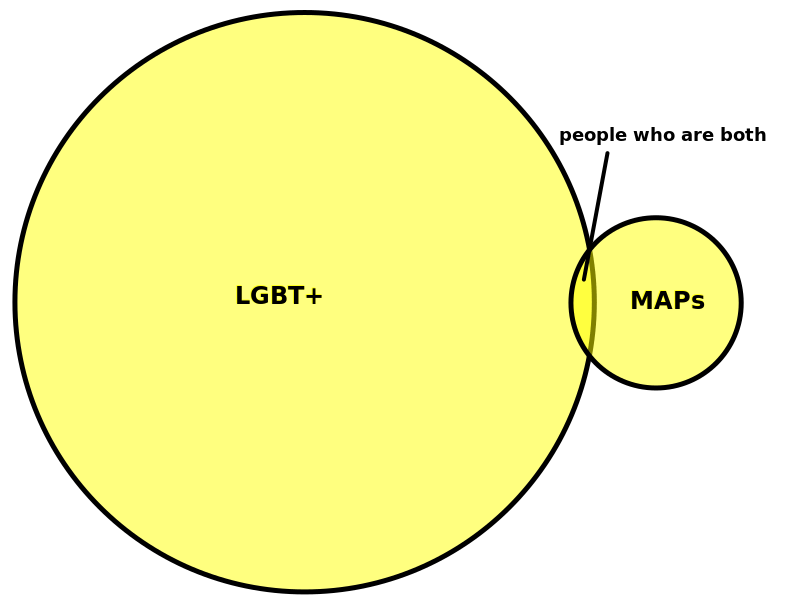
A 2018 viral hoax claimed MAPs (minor-attracted persons) were trying to join LGBT+. Much of the general public views MAPs as predators, so the hoax drew vehement resistance from many LGBT+ people. Who wants to be associated with predators? Of course it went over like a lead balloon!
Moreover, in LGBT+ history, this hoax was far from the first smear of its kind. Detractors of the LGBT+ community have consistently attempted to associate the community with child sexual abuse (CSA). They have likened gay men to pederasts. They have claimed transfeminine people using women’s restrooms are trying to molest little girls. More broadly, they have claimed LGBT+ influences corrupt children’s minds and morals.
None of the vilification is valid. Expressions of LGBT+ identities have no inherent association with sexual abuse of anyone, let alone children. Nevertheless, the LGBT+ community has long suffered from such perceptions.
Part of the muddied perception has involved organizational association. North American Man-Boy Love Association (NAMBLA), a pederasty advocacy group, used to be a member of the International Lesbian and Gay Association (ILGA). NAMBLA marched in some gay pride parades. The Associated Press reported in 1994, “[T]he annual gay pride march in Los Angeles excludes NAMBLA, but the marches in New York and San Francisco have allowed it to participate.” While not the most flattering depiction, this AP article notes, “The gay community has historically been inconsistent in its response to pedophiles, leaving itself open to attack.”
To their credit, ILGA eventually expelled NAMBLA. The ILGA website records, “In 1994, ILGA expelled NAMBLA and two other paedophile groups at its World Conference in New York. These groups had joined ILGA at an earlier stage of ILGA’s development, at a time when ILGA did not have in place administrative procedures to scrutinize the constitutions and policies of groups seeking membership.”
Human Rights Campaign in a 2010 statement also denounced CSA (which they likewise termed pedophilia).
Thus, the LGBT+ community’s vehement resistance to association with CSA did not suddenly arise in 2018; decades of controversy have formed it.
LGBT+ has historically been about 1) the gender one identifies as, if any; and 2) the gender(s) to which one is romantically or sexually attracted, if any. Minor attraction has nothing to do with the gender(s) one identifies as or is attracted to, if any.
Therefore, minor attraction lacks sufficient precedent for inclusion in LGBT+. The two must remain separate and distinct. Now this blog post should end here, having made its point… except for one problem.
The problem is the general public often conflates minor attraction and CSA. However, most MAPs never commit CSA, and most CSA is committed by non-MAPs (per Dutch Rapporteur ‘On solid ground. Tackling sexual violence against children.’ and B4U-ACT ‘Research Summary’). Like LGBT+ people, MAPs are vilified with a “Think of the children!” knee-jerk reaction. Acting in self-preservation, many LGBT+ people throw MAPs under the bus.
To protect children and preserve the integrity of LGBT+, one does not need to condemn MAPs. Minor attraction is unchosen. Simply having an attraction does not make us dangerous or despicable. Much of the general public views us as disgusting predators, so we live under the burden of stigma. We are pressured to hide and repress our attractions instead of being open and honest about them. If we disclose our attraction, we risk social ostracism, termination from employment, or vigilante violence even when we have done nothing reprehensible.
This piece explores the similarities and differences between LGBT+ and minor attraction. Finally it proposes a new, broad categorization.
Similarities
1) Minor attraction and LGBT+ sexualities are innate, inseparable from one’s personhood. One cannot love or accept a person while hating or rejecting their sexuality or gender. “I consider gayness sinful but I love gay people” doesn’t make sense, since gayness cannot be separated from the person. Likewise, “I detest minor attraction but I accept MAPs” is a harmful message.
The American Psychiatric Association (APA) removed homosexuality from the Diagnostic and Statistical Manual of Mental Disorders (DSM) in 1973. Then in 1974, they added ‘Sexual Orientation Disturbance,’ which classified homosexuality as a disorder only if it bothered the person:
Perhaps as a concession to those against the 1973 decision, a new revision of the DSM, called DSM II, was published in 1974 and replaced homosexuality with Sexual Orientation Disturbance, which regarded homosexuality as an illness only if the person was “disturbed by, in conflict with, or wished to change their sexual orientation” (APA DSM II). The DSM II noted that homosexuality by itself did not constitute a psychiatric disorder. A later edition […] renamed Sexual Orientation Disturbance as Ego Dystonic Homosexuality, but that too was removed in a revision in 1987 […]. (cedar.wwu.edu)
The DSM’s treatment of homosexuality from 1974 to 1987 is much like its current treatment of pedophilia. The DSM-5 considers pedophilia a disorder only if it bothers or impairs the person or they have committed CSA. The entry for Pedophilic Disorder explains:
However, if they report an absence of feelings of guilt, shame, or anxiety about these impulses and are not functionally limited by their paraphilic impulses […], and their self-reported and legally recorded histories indicate that they have never acted on their impulses, then these individuals have a pedophilic sexual interest but not pedophilic disorder.
2) Both have been targeted for conversion therapy. Individual psychiatrists and psychologists have attempted it, as well as entire organizations dedicated to it, against gay and trans people. On a smaller scale, it has been attempted against MAPs.
Perhaps the most common message MAPs receive from those who don’t understand us is “Get help!” It often comes from LGBT+ people who are okay with conversion therapy for certain sexualities but not for their own.
One’s sexuality cannot be changed by denial, repression, prayer, conversion therapy, chemical castration, or physical castration. For those last two, it is notable that some MAPs are assigned female at birth.
3) As stated above, detractors often invoke “Think of the children!” for both. I’m a MAP and LGBT+, specifically transfeminine. I use women’s restrooms because using men’s restrooms gives me dysphoria. Transfeminine people are already often perceived as predatory to little girls in restrooms. Knowing I’m also a MAP could give someone even greater reason to view me as a predator, compounded with my gender expression.
This is also why the blanket statement “MAPs aren’t LGBT+” is unhelpful, since some people are both. It would be more helpful to say, “Minor attraction isn’t LGBT+.”
4) People in both categories are disproportionately likely to have the anxiety/depression/suicide trifecta. This is due partly to stigma and pressure to hide and repress one’s innate qualities. People in both categories deserve to be able to talk about their genders and sexualities without stigma, shame, or condemnation.
5) Both can involve emotional or romantic attraction. It is common knowledge in the LGBT+ community that one’s sexual attractions and emotional/romantic attractions don’t always match. Also, it is common knowledge in the MAP community that minor attraction can be sexual or emotional/romantic. Some MAPs are asexual and have only emotional/romantic attraction to minors. Some MAPs are aromantic and have only sexual attraction to minors. Most MAPs have simultaneous sexual and emotional/romantic attraction.
A MAP can fall in love with a child in the same sense in which an adult falls in love with another adult. In such cases, it does not necessarily increase the risk of the MAP offending against the child. Rather, it can give the MAP that much more motivation to protect the child. It is also possible to love from a distance, to avoid crossing appropriate boundaries.
6) Both can be apparent in minors as well as in adults. Many minors are themselves MAPs. For example, a 14-year-old attracted to four-year-olds is a MAP because of the large age gap.
Differences
1) Adults can consent to sex with each other, but children cannot consent to sex with adults. Age matters for consent, but gender doesn’t.
2) The first gay rights organization in the United States, albeit short-lived, was the Society for Human Rights (1924-1925). The more successful Mattachine Society began in 1950 and made some progress, until the LGBT+ movement gained strong traction in 1969 with the Stonewall riots. The movement has been mostly supported by the Democratic Party, the Libertarian Party, and the Green Party. The Republican Party has mostly opposed it. It has won many victories in the public sphere.
The MAP movement, by contrast, began much more recently and has not yet received political attention. It is Internet-based because nearly all MAPs prefer to remain anonymous. Several students in psychology have studied MAPs in the MAP community, including questionnaires and one-on-one interviews. One such researcher is Crystal Mundy, M.A., whose dissertation is in committee review at the University of British Columbia.
For the sake of some readers, I stress Nathan D. Larson (former Libertarian, now independent) and Roy Moore (Republican) do not represent the MAP community. A good representative of the MAP community is Todd Nickerson, though he has not to my knowledge run for public office. I don’t know when or how the MAP movement will enter politics or what it will look like; but it will be more respectable than Larson, Moore, or NAMBLA.
3) LGBT+ people have historically been persecuted by governments and religions. MAPs have not been persecuted to anywhere near this extent, mainly because MAPs haven’t been as visible. As MAPs become more visible in the near future, MAPs will likely be persecuted to the same degree. Society always has a scapegoat minority.
Personally, I feel more marginalized for my minor attraction than for my nonbinary gender; the former is the one I have to hide and repress the most by far.
Proximation
Clearly, minor attraction and LGBT+ are separate categories. Some people are in both.
People in either category deserve social justice. While this looks slightly different between the categories, they have at least these three needs in common:
1) Neither should come with stigma, shame, or condemnation.
2) Both should have legal employment protections. This should include day care centers and K-12 schools, since attraction is not action; to suggest otherwise would be to make a stigmatizing assumption that they are inherently dangerous and untrustworthy.
3) Therapy for both should focus on the health and well-being of the person, not on prevention of sexual abuse, unless they have already offended or indicate they want help to keep from offending.
To express these common needs, some have suggested proximal categorization. One idea is the larger category ‘Gender and Sexual Minorities’ (GSM), which includes LGBT+ and minor attraction as separate subcategories. I like the gist of GSM. I would simply rename it for three reasons:
1) A group does not have to be a minority to be marginalized. In United States census data from 2000 and 2010, respondents identifying as female have slight majorities over those identifying as male. These data erase nonbinary identities, but the United States may very well have more women than men. Yet American women are still marginalized. To use an extreme example, at one point in ancient Sparta, slaves outnumbered citizens 8:1.
2) Not all sexual minorities are marginalized. Demisexuality and sapiosexuality are minorities yet not marginalized.
3) Some romantic attractions are in LGBT+, and these are not sexualities or genders. The general word attractions instead of the specific word sexualities would include romantic as well as sexual attractions.
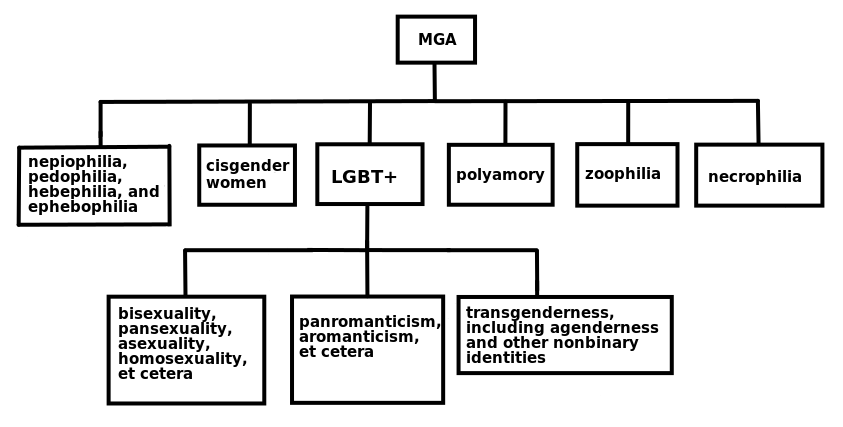
Accordingly, instead of ‘Gender and Sexual Minorities’ (GSM), I propose ‘Marginalized Genders and Attractions’ (MGA).
I would also include polyamory. There is debate as to whether to classify polyamory as inherently LGBT+, but it is an attraction. Its proper position in my proposed chart below may be different from where I have tentatively placed it.
I would also include zoophilia and necrophilia. Nobody deserves to live with stigma just for having an unchosen attraction.
Nothing fosters cooperation like a mutual opponent. Our MAP community has many opponents. When they harass us en masse, we collectively sound the alarm. Our attention shifts to rebutting them, trolling them, or protecting our Twitter accounts. During these times, we focus on outside adversity.
How about when outside adversity feels reduced? Our attention returns to within our community. We casually discuss concepts, joke around, et cetera. Yet it is not all peaceful. Disengaged from outside adversity, we return to our own quarrels. Most are fleeting.
However, one quarrel endures. What was a spectrum we have oversimplified into a binary. ‘Pro-contact’ and ‘anti-contact’ factions now bifurcate our community.
I am not arguing a contact position. Rather, I write this piece to show how to handle MAPs having different contact positions. After all, ideas are distinct from the people who have them. Our community is first and foremost one of people, who happen to have ideas.
To illustrate the separation of people from ideas, I present the example of United States Supreme Court Justices Antonin Scalia (1936-2016) and Ruth Bader Ginsburg (1933-). They usually disagreed on cases. And their views were of great consequence, since the Court’s rulings greatly impact people’s livelihoods and liberties.
Thus, it may surprise one to know Ginsburg and Scalia were close friends outside their duties on the Court. They had the closest friendship of any of the Justices! They vacationed together, attended opera together, and got together with their spouses.
In a 2008 interview with 60 Minutes’ Lesley Stahl, Scalia remarked, “I attack ideas. I don’t attack people. And some very good people have some very bad ideas. And if you can’t separate the two, you gotta get another day job. You don’t want to be a judge. At least not a judge on a multi-member panel.”
In 2016, at the Justice Scalia Memorial Service, Ginsburg eulogized him. She reminisced their interactions regarding the 1996 case United States v. Virginia, 518 U.S. 515. Informally called “the VMI case,” it would determine whether public military training institutions could refuse to admit women.
For the VMI case, Ginsburg was writing the majority opinion, while Scalia was writing the dissent. Scalia presented her with his penultimate draft. She deemed it “a zinger” and adjusted her own draft to address his arguments. She eulogized, “My final draft was much improved, thanks to Justice Scalia’s searing criticism” (emphasis hers).
While their views strongly opposed each other, they enjoyed each other. They knew they were not their views.
It’s fine if not all MAPs befriend each other. We’re not a panel of judges, either. I describe the dynamic between Scalia and Ginsburg only to emphasize the separation of ideas from people.
Labels create targets. When we assume a MAP’s nuanced views from a vague, binary label, we lose sight of the MAP behind the label. ‘Anti-contact’ and ‘pro-contact’ mean different things to everyone who uses them. Again, our MAP community is first and foremost one of people, who happen to have ideas.
What is our main purpose for having a MAP community? Here are some options:
To gain acceptance from society
To support each other’s wellbeing
To convince fellow MAPs to change their views
To keep each other from offending
To have a venue for joking or edgelording
Any given MAP may have any combination of these goals. Do they all feel equally important? If you’re a MAP, ask yourself, “What do I most desire with our community?” Two or more goals may tie for first place. While I can’t predict your main goal, I am suggesting one.
What helps me narrow it down is asking, “What can the MAP community do that no other group can, or better than any other group? What can we get from the MAP community, or offer to it, that we can’t get or offer anywhere else?”
To me, the answer is clear: supporting each other’s wellbeing. Nobody understands us as well as we do.
There are many venues for social activism, within or without a community context. Many organizations work to prevent child sexual abuse. Plenty of informational and persuasive sources are directed at MAPs. The Internet has countless outlets for jokes and edgelording. All these interests matter, but our community’s uniqueness lies in our ability to understand and support each other. I can only hope you agree.
Some MAPs, regardless of views, want or need therapy to keep from offending. In the current social climate, all MAPs need therapy to help handle stigma. A MAP’s contact stance has no bearing on their innate value as a person deserving therapy, support, and validation. There may be valid criticisms of various contact stances, but these are already stated often enough. What all MAPs need now is unconditional acceptance for who we are. We must not allow criticism of views to obscure people who have views.
Discourse on MAPs revolves too much around behavior. MAPs in some circles hear, “You are valid and accepted, and it’s okay to do X with minors.” MAPs in other circles hear, “You are valid and accepted, but don’t do X with minors.” Even though these messages are from opposing perspectives, they both emphasize behaviors.
MAPs need a message that is immutable regardless of behavior. We need unconditional acceptance. We need to hear simply, “You are valid and accepted,” without qualification.
Beyond the idea-centered contact quarrel, or the behavior-centered encouragements not to offend, we need this person-centered approach to MAP relations.
Update on September 1, 2022: Perhaps due in part to my whiteness, I overemphasized the role of therapy. MAPs who feel no need for therapy to handle stigma are valid. It is also worth noting that conventional western psychotherapy, while helpful, is a relatively new invention in human history.


 Mx. PDFphile